
Public vs. Private Swim Lessons in Austin: How to Find the Right Fit for Your Child
Not all swim programs are the same. That might sound obvious, but most parents simply don’t fully appreciate what it means until they’ve watched their child spend two or three summers in lessons without meaningfully improving. The difference between a program that produces a confident, capable swimmer and one that produces a child who has just attended swim class isn’t always clear from a registration page.
It comes down to how the program is actually built.
The thing about Austin is that it has no shortage of options; the City of Austin runs programs at aquatic facilities across the area, private swim schools operate year-round at indoor locations, and recreation centers and club programs fill in the gaps. If you’re trying to figure out which direction to go, the real question isn’t as simple as public versus private. It’s what factors actually determine how well and how quickly a child learns to swim, and which kind of program gets those things right!
The Calendar vs. the Child: How Advancement Should Actually Work
Most city and community swim programs in Austin use a session-based model, meaning classes run in fixed blocks of six to eight weeks and advancement from one level to the next happens when the session ends, not when a child is actually ready for what comes next. It is a practical structure for managing enrollment at scale. It is not always a practical structure for learning.
Think about what that means for a child who is three-quarters of the way to mastering her current level when the eight weeks run out. She’s made real progress, but the next session starts from the beginning of that same level. She’ll spend the first few weeks reviewing skills she already had. Some of what she built over the summer has faded during the gap between sessions. Her parents re-enroll in good faith, not realizing the structure itself is unfortunately working against her.
Private swim schools tend to handle advancement differently. A child moves to the next level when they have genuinely demonstrated they are ready, regardless of where they are in any session block. If that happens in week three, they move in week three. If they need more time, they get it without being rushed forward on a schedule that has nothing to do with where they actually are. The program adjusts to the child rather than the other way around.
That single structural difference has more impact on long-term development than almost anything else. It is the first question worth asking when you are comparing any two programs, public or private.
Class Size: Why It’s More Important Than You Think

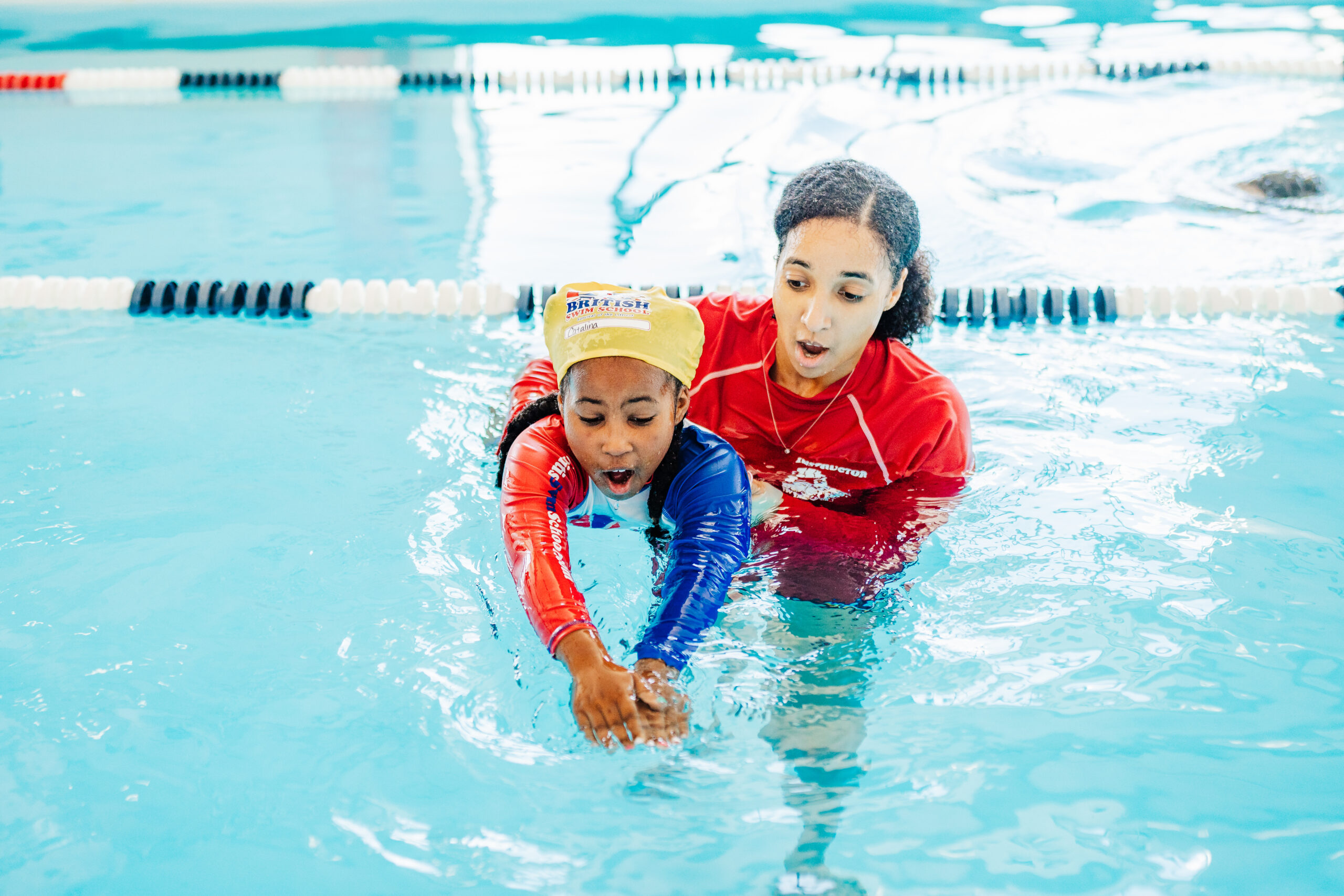
There is a version of group swim lessons where the instructor spends most of the class managing eight or nine kids at the wall, rotating through each one briefly and moving on. Every child gets a turn. No child gets enough. The quieter kids, the hesitant ones, the kids who are close to a breakthrough but not quite there, those are the children who need the most individual attention, and in a large group setting they tend to get the least of it.
The difference between that environment and a class of four is not marginal. It is the difference between instruction and supervision. In a small group, an instructor can watch each child attempt a skill, correct form in real time, and actually track how a swimmer is developing week over week. They know which child tends to tense up on the back float. They know who is two sessions away from moving up. That kind of attention is only possible when the numbers allow it.
City programs vary in class size by facility and level, but entry-level classes at public pools routinely run larger than what you will find at a quality private school. When you are evaluating any program, ask specifically about the ratio at the level your child would start in, not the most favorable number on the website, but the actual class size for beginners at that location.
Instructor qualifications tell a very similar story. There is a noticeable difference between a certification earned once during a hiring process and an instructor who is actively observed and coached over time. Private schools that build ongoing training and evaluation into their operations deliver more consistent instruction because the standard doesn’t depend on who happens to be staffing that summer.
What Happens to Swim Skills Between September and June
Austin doesn’t really have an off-season when it comes to water; Barton Springs stays open well into fall, neighborhood pools run through October, and families spend weekends at Lake Travis, Hamilton Pool, and the Greenbelt for most of the year. For an Austin child, the water here is part of everyday life, which makes what happens to their swim skills between September and June more consequential than most parents realize.
City of Austin aquatic programs run their heaviest schedules in summer, some facilities offer reduced programming in fall and spring, and certain pools close or cut hours significantly outside of peak season. A lot of children who finish a summer session confidently aren’t back in a structured class until the following year. And that gap is longer than it feels.
Swimming relies on habit and physical memory, the kind that only stays sharp with regular practice! A child who has learned to float and roll to breathe in August is not the same swimmer the following June if they have spent months away from the water. The skills are still in there, but they are no longer automatic. The early weeks of re-enrollment tend to look a lot like the early weeks of first enrollment, and families who have been through that cycle more than once know exactly what it feels like.
Private programs built around year-round indoor instruction eliminate that reset. Children who stay in the water consistently through fall and winter are not just maintaining what they learned over the summer. They are building on it every week. The hours between a child who trained year-round and one who did two summers only are not dramatically different. The results are.
How British Swim School of Austin Teaches
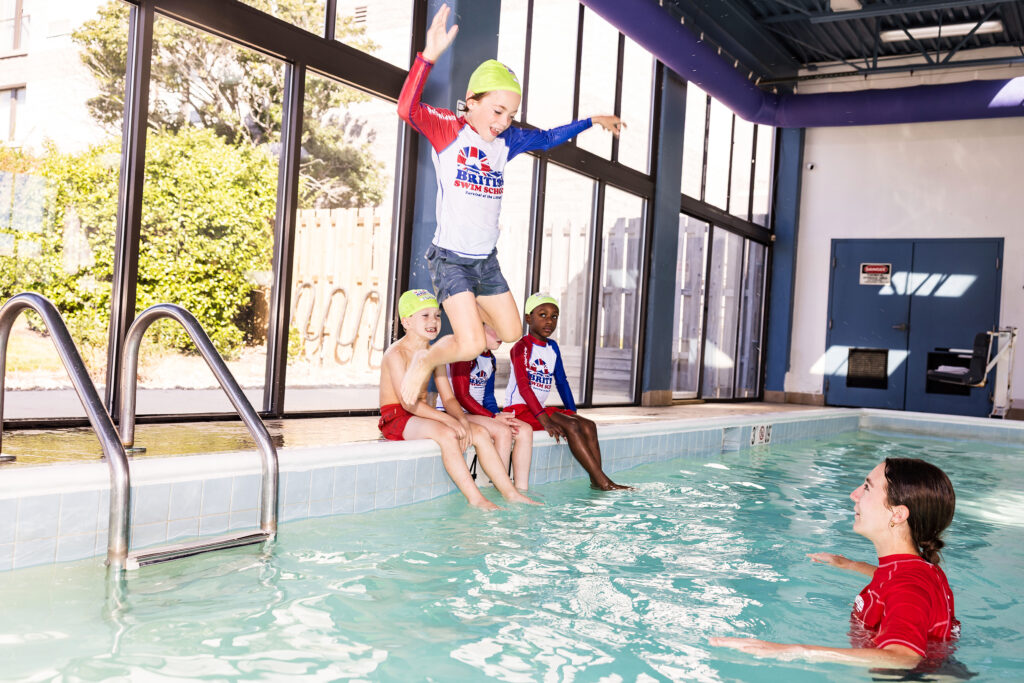
British Swim School was built on one premise: learning to be safe in the water comes before anything else. Every part of how the programs are structured, such as the curriculum sequence, the class sizes, and the way instructors are trained follows from that starting point.
The curriculum begins with survival skills. Before swimmers work on freestyle or backstroke, they learn what to do if they find themselves unexpectedly in the water. Floating, rolling to breathe, staying calm, and reaching safety are introduced first and reinforced at every level that follows. Stroke technique is built on top of that foundation, not in place of it. For families who want their child to be genuinely safe in the water before they are fast in it, that sequence is crucial.
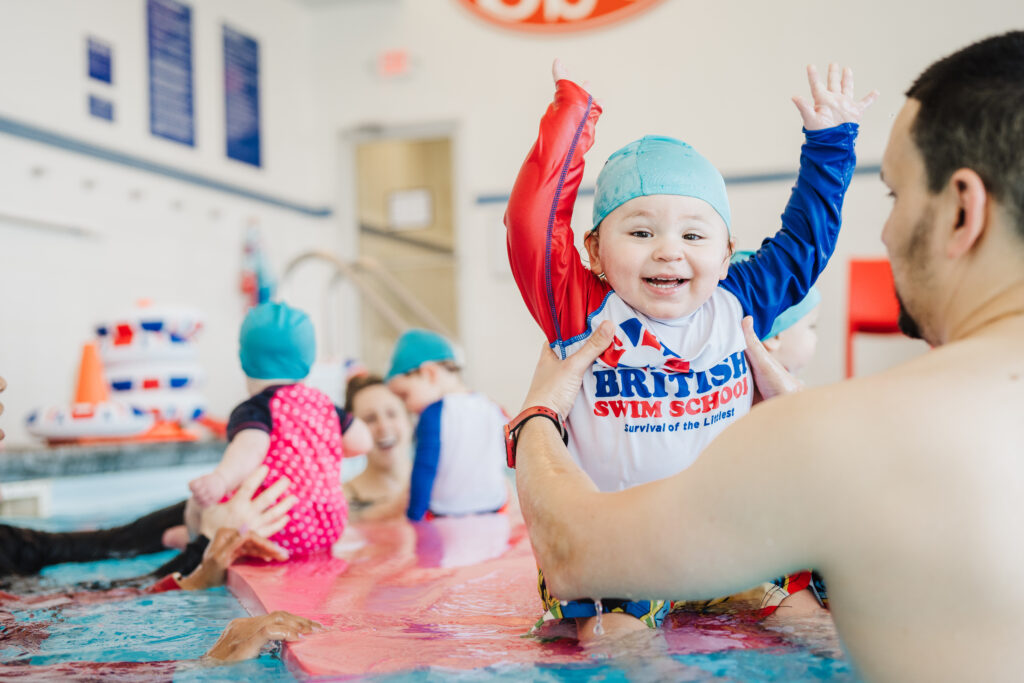
Classes for independent swimmers are capped at four students per instructor. The earliest parent-and-child classes run at six to one, with a caregiver in the water alongside each child. Instructors complete British Swim School certification and hold national lifeguard and first aid credentials before teaching solo, and are observed and evaluated on a regular basis after that. Advancement is skill-based throughout, a child moves when they are ready, not when the calendar says it is time. Enrollment is rolling year-round, so there is never a wrong time to start!
Austin-Area Locations
Between summer and year-round options, British Swim School of Austin operates at eleven pool locations across Central Texas:
- Holiday Inn Express | 15295 I-35, Buda, TX 78610
- Paragon Prep | 831 Houston St, Austin, TX 78756
- Rio Vista Pool | 555 Cheatham St, San Marcos, TX 78666
- Sunfield | 1328 Sunbright Blvd, Buda, TX 78610
- James Adkins Pool | 1100 W Center St, Kyle, TX 78640
- Courtyard Austin Parmer / Tech Ridge | 12330 N Interstate Hwy 35, Austin, TX 78753
- Wingate New Braunfels | 245 FM306, New Braunfels, TX 78130
- San Marcos Academy | 2801 Ranch Rd 12, San Marcos, TX 78666
- 24 Hour Fitness Austin NW | 10616 Research Blvd, Austin, TX 78759
- 24 Hour Fitness Hancock Center | 1000 East 41st St, Austin, TX 78751
- LA Fitness South Lamar | 4001 S Lamar Blvd, Austin, TX 78704
Frequently Asked Questions
What is the difference between public and private swim lessons in Austin?
City programs through Austin Parks and Recreation run on seasonal schedules with session-based advancement and tend to have larger class sizes. Private programs offer year-round access, smaller classes with defined instructor ratios, and skill-based advancement where children move up when they are ready rather than when a session block ends.
Are city of Austin swim lessons available year-round?
Availability varies by facility. Summer is the peak season for city aquatic programming and some facilities reduce hours or close pools outside of summer months. British Swim School runs year-round at indoor, heated locations throughout the greater Austin area, including Austin, Buda, Kyle, San Marcos, and New Braunfels.
What age can children start private swim lessons in Austin?
British Swim School of Austin welcomes swimmers starting at three months old. The earliest classes are parent-and-child in the water together, focused on water comfort and early safety fundamentals. Enrollment is also open for older beginners, teens, and adults at all skill levels.
How many children are in a class at British Swim School of Austin?
Classes for independent swimmers are capped at four students per instructor. Parent-and-child classes for the youngest swimmers run at six students per instructor with a caregiver in the water for each child. Class sizes are kept small by design.
Does it matter if swim lessons are seasonal or year-round?
Yes, more than most families expect. Swim skills require regular practice to stay sharp, and children who take a months-long break between sessions typically spend the early weeks of re-enrollment recovering ground they had already covered. Year-round programs with consistent weekly practice produce significantly better results over time.
How do I find the right swim class level for my child in Austin?
British Swim School of Austin offers a free Swim Assessment at https://britishswimschool.com/austin/find-a-lesson/ that helps place your child at the right starting level across any of the eleven Austin-area locations. You can also call 512-763-7946 to speak with the team directly.
Making the Right Call for Your Family
After lessons conclude, you’ll either have a child who can swim or a child who has been in swim classes. That gap is rarely about whether you went public or private. It’s about whether the program treated swimming like a real skill to be developed, or an activity to participate in.
The questions in this guide are the ones that get you to the right answer: ask them out loud, pay attention to whether the program you are evaluating welcomes the scrutiny or sidesteps it. That alone will tell you more than any brochure ever will.
British Swim School of Austin is enrolling now across the greater Austin area! To find the right class and level for your child, take the free Swim Assessment at or call 512-763-7946.
 Use My Current Location